



Small Organizations, Big Targets
The assumption that cyberattacks are primarily a large enterprise problem has been definitively disproven. In 2026, SMEs account for 43% of all cyberattack targets globally - and only 14% of businesses in this sector feel realistically prepared to fend off an incident.
This gap exists for predictable reasons. SMEs typically operate with smaller IT teams, tighter budgets, and less organizational capacity for sustained compliance programs. But they face the same threat landscape as enterprises, increasingly the same regulatory obligations (NIS2 captures many SMEs in critical sectors), and the same operational consequences when an attack succeeds.
The good news is that genuine cyber resilience does not require an enterprise budget. It requires a clear understanding of what resilience actually means - and a focused approach to building it.
This guide provides a practical framework for SMEs building cyber resilience in 2026: what to prioritize, where common gaps concentrate, and how to demonstrate compliance when regulators come asking.
Why SMEs Are Now the Primary Target
The shift in attacker focus toward SMEs is not accidental. Several structural factors have made smaller organizations the path of least resistance for sophisticated threat actors:
The supply chain entry point. Large enterprises have significantly hardened their direct attack surfaces. Attackers have adapted by targeting the smaller organizations in their supply chains - organizations with access to enterprise systems but without enterprise-grade security controls.
Ransomware economics. Modern ransomware operations are run as professional businesses with customer support, pricing tiers, and affiliate networks. SMEs are targeted because they are more likely to pay quickly - they lack the incident response resources to contain an attack, and a week of downtime can be existential.
Regulatory extension. NIS2 extended its scope significantly compared to the original NIS Directive. SMEs operating in sectors classified as essential or important - and many do, across energy, health, transport, and digital infrastructure - are now subject to the same fundamental security requirements as large enterprises.
The Four Pillars of SME Cyber Resilience
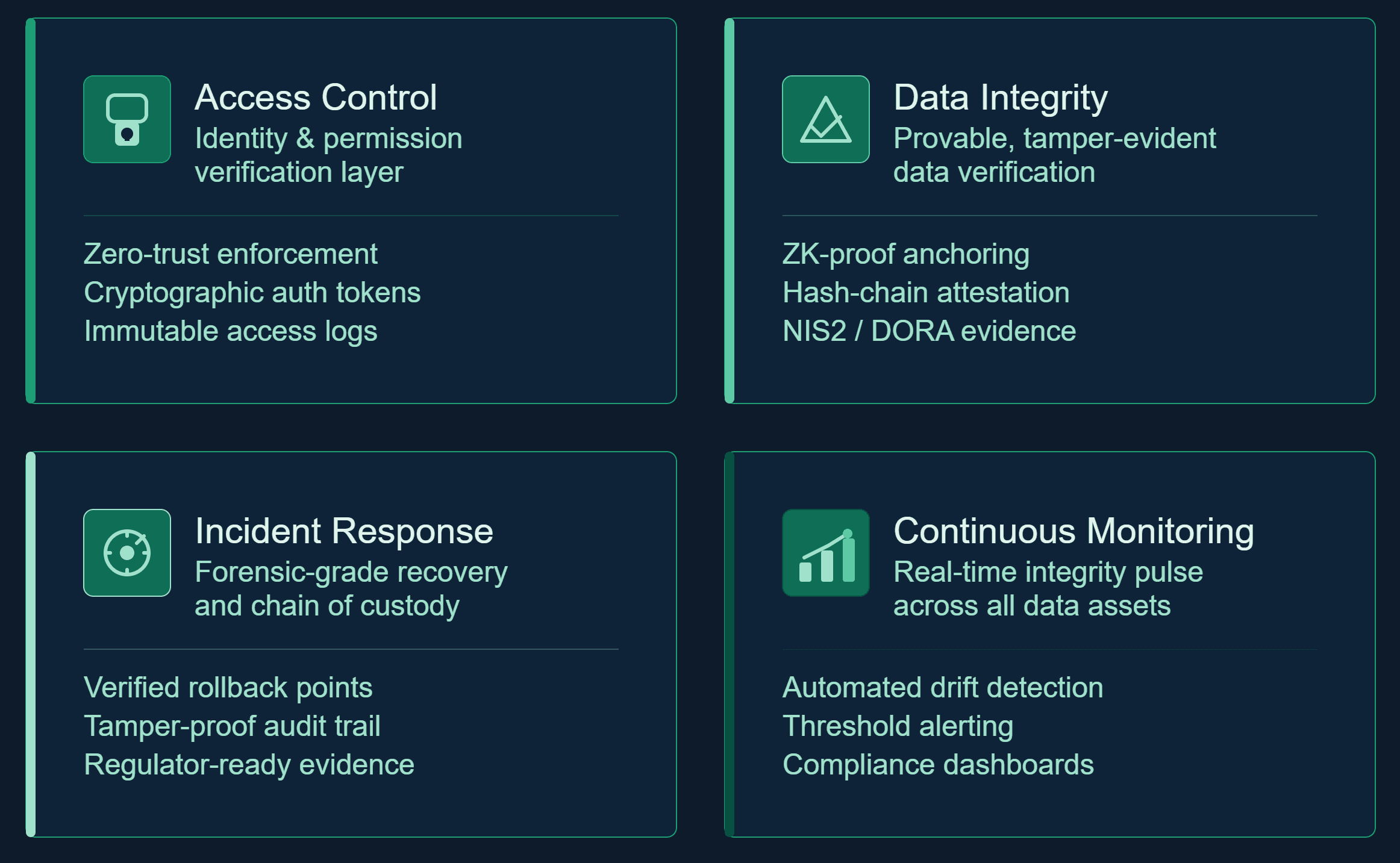
Resilience for SMEs should be built around four practical pillars. Each addresses a different failure mode and together they cover the most common pathways through which SME attacks succeed and escalate.
- Access Control and Identity Management. Most SME breaches begin with compromised credentials or excessive access rights. Implement multi-factor authentication across all critical systems, enforce the principle of least privilege, and maintain an up-to-date inventory of who has access to what. For organizations subject to NIS2 or DORA, documented access control policies with evidence of enforcement are a compliance requirement.
- Data Integrity and Verified Backups. Backups are necessary but not sufficient. A backup that has been infected by ransomware before the backup ran, or that cannot be verified as unmodified, is not a recovery asset. Implement cryptographic verification of your backup integrity so that when you need to recover, you know with certainty which state is clean. ROOTKey's verifiable trust infrastructure provides this capability: every backup state is anchored and verifiable.
- Incident Detection and Response Readiness. Early detection dramatically reduces the cost and duration of cyber incidents. Implement basic endpoint detection and monitoring, establish clear escalation paths, and define your first-response procedures before you need them. For NIS2-scoped organizations, a rehearsed 24-hour initial notification process is a regulatory requirement.
- Continuous Monitoring Over Periodic Audits. The most costly discovery is the one made months after an attacker first gained access. Continuous monitoring - even at a basic level - closes this gap. Prioritize monitoring your most critical systems: the ones that, if compromised, would stop your operations or expose your customers' data.
Building Without an Enterprise Budget
The practical constraint for most SMEs is not ambition - it is resource. Building a comprehensive security program from scratch is not realistic for a 50-person organization with a part-time IT function. The key is sequencing: do the highest-impact things first and build incrementally.
Start with access control. MFA and least-privilege access reduce the blast radius of any compromise. These are low-cost, high-impact controls that require no specialized expertise to implement.
Next, verify your backup integrity. If your backup strategy is 'we run nightly backups,' that is not a resilience strategy - it is an assumption. Verify that your backups are clean, complete, and recoverable. Tools like ROOTKey make this cryptographically verifiable rather than reliant on hope.
Then, establish your incident response basics. A one-page response playbook, a clear contact list for your managed security provider and relevant authorities, and a practiced communication process are more valuable than a sophisticated tool your team does not know how to use.
Finally, look at your regulatory obligations. If you are in a sector covered by NIS2, DORA, or the EU Cyber Resilience Act, identify exactly what is required of you and build your compliance documentation alongside your technical controls - not as a separate exercise.
From Compliance to Confidence
The goal of cyber resilience is not a certificate or a compliant checkbox. It is the operational confidence that when something goes wrong - and in 2026, the question for most organizations is when, not if - you have the controls to detect it, the evidence to understand it, and the verified clean data to recover from it.
ROOTKey was built to give organizations of any size that confidence. A free plan that covers essential integrity verification. A path to enterprise-grade verifiable trust infrastructure as your organization scales. And the compliance evidence that regulators, insurers, and partners increasingly require.
Start building your cyber resilience foundation with ROOTKey - free plan available, live in days, no credit card required.
Recebe insights de ciber-resiliência no teu email
Orientação prática e pronta para auditoria sobre integridade de dados, conformidade e continuidade - à medida que publicamos.